


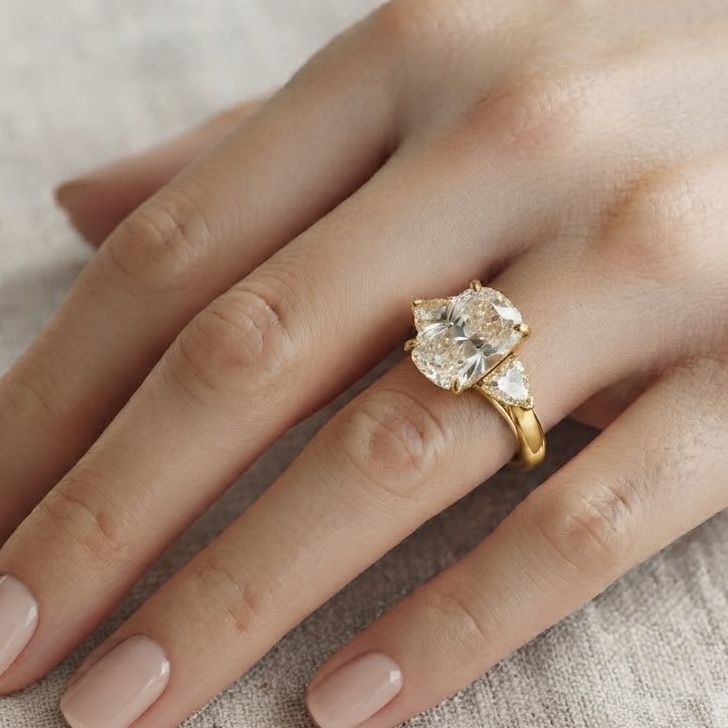


Lab Grown Diamonds FAQ
Are Lab Grown Diamonds cheaper than Natural Diamonds?
Yes, Lab Grown Diamonds are considerably more affordable. As a general guide, lab-grown white diamonds are typically around 30–40% less expensive than their naturally mined counterparts. Similarly, lab-grown fancy coloured diamonds can offer significant savings compared to mined equivalents, which are far rarer and command higher prices due to natural scarcity.
You may be wondering why there is a price difference if Lab Grown Diamonds are equivalent to mined diamonds in terms of chemical, physical, and optical properties. The answer lies primarily in rarity and supply dynamics. Regardless of whether a diamond is mined or grown in a laboratory, you are still receiving a real diamond. The choice between the two is therefore often guided by factors such as budget, personal preference, design selection, and environmental & ethical considerations.
Are they Softer than Natural Diamonds?
They are Diamonds – They are Identical!
Lab Grown Diamonds are created using the same elements found in natural mined diamonds. They are grown by recreating the extreme pressure and temperature required to transform carbon into the same diamond crystal structure found in nature.
Lab Grown Diamonds possess the same chemical composition, crystal structure, optical properties, and physical properties as mined diamonds. They are real diamonds, not imitations, simulants, or substitutes.
Because Lab Grown Diamonds are real diamonds, they possess the same strength, durability, and hardness as mined diamonds. This makes them exceptionally resistant to scratching and ideal for everyday wear. Diamonds are approximately 10 times harder than sapphire and around 100 times harder than cubic zirconia, making them one of the most durable materials used in fine jewellery.
What Shapes do they come in?
Once created, lab-grown diamonds are cut and polished in the same manner as mined diamonds. As a result, they are available in all the popular diamond shapes, including Round Brilliant, Oval, Pear, Princess, Cushion, Emerald, Radiant, Marquise, Heart, and more.
What Grade are they?
Lab-grown diamonds are graded using the same internationally recognised criteria as mined diamonds — the Four C’s: Cut, Colour, Clarity, and Carat. They are also assessed by the world’s leading gemmological laboratories, the same institutions that grade earth-mined diamonds.
We only source and supply diamonds certified by reputable, independent grading laboratories to ensure consistency, accuracy, and confidence in every stone we offer.
Are they Certified?
Me Jewellery offers diamond certification with all Lab Grown Diamonds over 0.30ct. Most lab-grown diamonds are certified by leading independent gemmological laboratories such as the International Gemological Institute (IGI), Gem Certification & Assurance Lab (GCAL), or the Gemological Institute of America (GIA).
In addition, all of our Lab Grown Diamonds are laser inscribed with a unique identification number, providing clear traceability and added confidence in the stone’s origin and certification details.
Can a Jeweller or my friends tell if my Lab Grown Diamond is not a Naturally Mined Diamond?
The short answer is no. Lab Grown Diamonds share the same carbon structure and physical properties as naturally formed diamonds. Standard diamond testers will therefore confirm that they are genuine diamonds.
However, determining whether a diamond is lab-grown or naturally mined requires more advanced testing. Only specialised gemmological equipment or laboratory analysis can identify the diamond’s true origin.
Are Lab Grown Diamonds colourless and flawless?
As with natural diamonds, Lab Grown Diamonds can exhibit variations in colour and clarity, and are graded and certified in the same way using established gemmological standards.
Are they the same as Cubic Zirconia’s or Moissanites?
It is important to understand the distinction between Lab Grown Diamonds and diamond simulants. Lab Grown Diamonds are real diamonds, composed of carbon atoms arranged in the characteristic diamond crystal structure (an octahedral lattice). They share the same chemical, physical, and optical properties as natural mined diamonds.
Diamond simulants, such as cubic zirconia and moissanite, are not diamonds and do not share the same carbon crystal structure. These materials are significantly lower in cost and differ in their chemical and physical properties.
Simulants also have a lower hardness compared to diamond, making them more susceptible to scratching over time. They do not exhibit the same light performance, brilliance, and scintillation associated with a well-cut diamond.
Will Lab Diamonds hold their value?
At this stage, it is difficult to predict how Lab Grown Diamonds will perform in terms of long-term resale value. While demand is currently strong, and production capacity continues to grow, the market for Lab Grown Diamonds is still evolving, which may influence future pricing trends.
Like most diamonds, Lab Grown Diamonds are typically purchased as a symbol of love, commitment, and personal significance rather than as an investment asset. For many, their value is primarily sentimental, and they are often treasured and passed down through generations.
It is also worth noting that the resale market for both natural and lab-grown diamonds can be limited, and prices on resale may differ significantly from original purchase prices. Ultimately, time will continue to shape how value is perceived in this category.
Pictured below: Lab-Grown Diamond Creation Methods & Natural Diamond Crystal Formation

What is the difference between CVD and HPHT Lab Grown Diamonds?
HPHT Diamond Growth Method
The first successful synthetic diamonds were created by replicating natural conditions using the High Pressure High Temperature (HPHT) method. Over time, three main types of HPHT presses have been developed to produce and enhance diamonds:
- Cubic Press
- Belt Press
- Split-Sphere (BARS) Press
The objective of each method is to recreate the extreme heat and pressure conditions found deep within the Earth. All HPHT processes begin in the same way, with a small diamond seed placed in a carbon source and subjected to controlled high pressure and high temperature conditions.
Developed by the General Electric Company, the Belt Press uses opposing anvils to apply pressures exceeding 1.5 million pounds per square inch, alongside temperatures above 2,000°C. Under these conditions, carbon dissolves and gradually crystallises around the diamond seed, forming a larger diamond crystal.
On December 16, 1954, the first successful lab grown diamond was produced using the Belt Press method. Although small and slightly opaque, it marked a major breakthrough and paved the way for further advancements in synthetic diamond technology.
Since the 1950s, HPHT technology has advanced significantly. Early Belt Press systems have been scaled and refined, while newer methods such as the Cubic Press and BARS (Split-Sphere) Press have improved efficiency and allowed for the production of higher-quality gem-grade diamonds.
HPHT diamonds are generally classified as Type II. The growth method is typically disclosed on a diamond’s grading report or certificate.
CVD Diamond Growth Method
Chemical Vapour Deposition (CVD) is a modern method used to produce Lab Grown Diamonds. The process utilises a hydrocarbon gas mixture and begins with a thin diamond seed, typically a slice of an HPHT-grown diamond. This seed is placed inside a sealed, heat- and pressure-controlled chamber and heated to approximately 800°C.
The chamber is then filled with a carbon-rich gas, usually methane, along with other gases. These gases are ionised into plasma using microwaves, lasers, or similar energy sources. This process breaks the molecular bonds within the gases, releasing carbon atoms that gradually deposit onto the diamond seed. Over time, the crystal grows atom by atom, layer by layer, forming a diamond structure.
There are several variations of the CVD process, including:
Microwave Plasma Chemical Vapour Deposition (MPCVD)
Plasma Enhanced Chemical Vapour Deposition (PECVD)
Low Pressure Chemical Vapour Deposition (LPCVD)
Ultra-High Vacuum Chemical Vapour Deposition (UHVCVD)
Compared to HPHT, the CVD method does not require extreme pressure and operates at significantly lower temperatures. It also allows for larger growth areas on seed plates, improving yield and efficiency. In addition, the process provides greater control over growth conditions, enabling fine-tuning of diamond quality.
A CVD diamond typically takes around 6–12 weeks to grow into a sizeable rough crystal.
CVD diamonds are commonly Type IIa, a classification characterised by very high purity and low nitrogen content. In contrast, only a small percentage of natural diamonds fall into this category. Type IIa diamonds are known for their exceptional transparency and specific optical properties. As a result, specialised gemmological instruments can sometimes indicate whether a diamond is potentially CVD-grown.
Ongoing research continues to advance CVD technology, allowing for the production of diamonds in a range of colours, sizes, and clarity grades. These diamonds are physically, chemically, and optically identical to natural diamonds and are increasingly recognised as a significant part of the modern diamond market.
The growth method is typically disclosed on a diamond’s grading report or certificate.
What does Post-Growth Treatment mean?
What is Post Growth Treatment in Lab Grown Diamonds?
Some Lab Grown Diamond certification reports will indicate the growth method and whether any post-growth treatment has been applied.
As with any manufacturing process, natural variations can occur during diamond growth. Lab Grown Diamonds are no exception, and in some cases may exhibit irregular colour or clarity characteristics after formation. Where necessary, additional processes such as controlled heat treatment may be used to refine or adjust a diamond’s colour and appearance.
Common report notations may include:
- As Grown – No indication of post-growth treatment.
- HPHT (High Pressure High Temperature) – A man-made diamond created using the HPHT growth process; no evidence of treatment detected. (Type II)
- CVD (Chemical Vapour Deposition) – A man-made diamond created using the CVD growth process; may show evidence of post-growth treatment to modify colour.
It is important to note that many fancy coloured Lab Grown Diamonds undergo some form of post-growth treatment to achieve their final colour appearance.

