Facebook Pixel tracking image
Mini Cart 0

Your cart is empty.

FREE SHIPPING - 100% AUSTRALIAN DESIGNED & CRAFTED

Mini Cart 0

Your cart is empty.

PEARL EDUCATION

Pearls and their Lustre
Lustre

Lustre refers to the deep, luminous glow visible on a pearl’s surface. It is created as light reflects and refracts through the pearl’s outer layers, known as nacre. The quality and thickness of the nacre play a significant role in determining the intensity, brilliance, and iridescence of a pearl’s lustre.

Widely regarded as the most important characteristic of a pearl, lustre is what distinguishes pearls from all other gemstones. Not only does it greatly influence a pearl’s beauty and visual appeal, but it is also one of the most significant factors affecting its value.

Surface

A pearl’s outer skin is referred to as its surface. As pearls are formed by successive layers of nacre deposited by a living mollusc, it is common for natural characteristics and imperfections to develop over time. The surface quality of a pearl should generally be considered in two ways:

1. Blemishes
These include surface imperfections such as spots, bumps, chips, scratches, pits, or wrinkled areas. The fewer blemishes present, the more valuable the pearl is likely to be.

2. Pearl Grain
Pearl grain refers to the texture and structure of the pearl’s surface. Depending on how tightly the nacre layers are formed, the grain may be more or less visible. Pearls with a tighter, smoother nacre structure typically display less visible grain, resulting in a higher lustre and a more refined appearance.

A Pearls Surface
Pearl Shapes
Shape

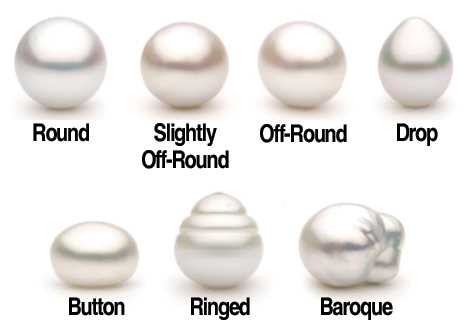
Even with today’s cultured pearls, shape can vary considerably. It is probably no surprise that the most sought-after and valuable pearls are those that are perfectly spherical or round. In fact, only a small percentage of cultured pearls achieve a truly round shape.

Pearl Shapes Include:

Round – A perfectly spherical pearl. A pearl is considered round when the variation in its diameter is less than 2.5%. For example, a pearl measuring 10mm may vary by up to 0.25mm and still be classified as round.

Near Round – A pearl with only slight variations in shape. Although it may appear perfectly round to the naked eye, a pearl is classified as near round when the variation in its diameter exceeds 2.5%.

Drop – A pearl with a longer vertical axis than horizontal axis, resembling a water droplet. This category includes teardrop, oval, and egg-shaped pearls.

Button – The opposite of a drop shape, a button pearl has a shorter vertical axis than horizontal axis, resulting in a flattened appearance.

Baroque – An asymmetrical or free-form pearl with an irregular, often highly unique shape. When part of the pearl displays a degree of symmetry or roundness, it may be classified as semi-baroque.

Circle – A pearl characterised by one or more concentric grooves, rings, or bands that encircle its surface.

Size

This aspect of pearl grading is relatively straightforward. All pearls are measured in millimetres (mm) using highly accurate, calibrated measuring instruments. In most cases, pearls are measured by their outside diameter.

Size is an important factor in determining a pearl’s value. The size range of pearls varies considerably depending on the species of pearl oyster. Pearls can range from as small as 3mm to over 20mm in diameter. Larger pearls are most commonly associated with South Sea and Tahitian pearls, as they are produced by some of the largest pearl oysters in the world.

Me Jewellery is proud to offer Broken Bay Akoya Pearls on the Central Coast, with sizes typically ranging from 6mm to 10mm.

Off-round, drop, button, and baroque pearls are usually measured by both their widest point and their longest point. However, measurement methods can vary among suppliers, particularly for irregularly shaped pearls.

Another technique used in the pearl industry is sieving, in which pearls are sorted by passing them through a series of precisely sized holes. This method allows pearls to be grouped accurately according to their size.

Pearl Education 1
Pearl Colours
Colour

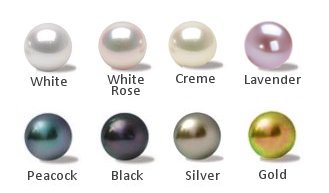
The colour of a pearl is determined primarily by the species of oyster in which it grows. However, environmental factors such as water quality, temperature, and growing conditions can also influence a pearl’s colour, overtone, and surface characteristics.

South Sea pearls derive their magnificent colour and exceptional lustre from the Pinctada maxima, also known as the Silver-Lipped or Gold-Lipped Oyster. These oysters typically produce pearls in shades of white, ivory, silver, and blue, often displaying beautiful pink and green overtones. They are also responsible for the highly prized Golden South Sea Pearls, which occur naturally in shades ranging from cream and champagne through to rich gold.

Tahitian pearls are renowned for their remarkable natural colour palette. Produced by the Pinctada margaritifera, or Black-Lipped Oyster, they occur in shades of aubergine, peacock, green, grey, blue, and black, often accompanied by striking iridescent overtones.

Akoya pearls are celebrated for their exceptional lustre and classic beauty. Produced by the Pinctada fucata martensii oyster, they are most commonly found in shades of white, cream, and ivory, often displaying the soft pink overtones for which Akoya pearls are famous. It should be noted that some Akoya pearls are treated or dyed to enhance their colour.

The Central Coast’s Broken Bay Akoya Pearls display an extraordinary range of naturally occurring colours, including silver-blue, silver-pink, silver-white, white, champagne, and gold. Their unique colour palette reflects the distinctive environmental conditions of the waters in which they are cultivated.

Images used on this page are sourced from third-party providers and are not affiliated with Me Jewellery. They are used under the principle of “fair use” for educational and illustrative purposes. If you are the rights holder and would like any image removed, please contact us and we will promptly take it down.

https://en.wikipedia.org/wiki/Fair_use