





The majority of diamonds do not fluoresce. In a study of more than 26,000 diamonds submitted to the GIA for grading, researchers found that only approximately 25% to 35% exhibited some degree of fluorescence when examined under a standard long-wave ultraviolet (UV) lamp. Therefore, it is likely that the diamond you are considering will not display fluorescence.
Source: GIA (Gemological Institute of America).
The answer is yes — lab-grown diamonds can fluoresce. It appears they fluoresce at a lower rate than natural earth-mined diamonds, however fluorescence can still occur. Most white or colourless lab-grown diamonds do not display noticeable fluorescence, whereas many fancy coloured lab-grown diamonds often do.
In many fancy coloured lab-grown diamonds, fluorescence can even enhance the diamond’s overall colour appearance.
Diamonds that fluoresce will only do so when exposed to ultraviolet (UV) light. You may notice your diamond fluorescing under bright sunlight, in tanning salons, nightclubs, or other environments with strong UV lighting.
Once the UV light source is removed, the diamond will immediately stop fluorescing. Standard indoor lighting, such as incandescent lighting, will generally not cause a diamond to fluoresce.
Diamond fluorescence cannot always be detected with the naked eye. In order to observe fluorescence, ultraviolet (UV) light must be present and the fluorescence intensity must be strong enough to be visible.
Reputable grading laboratories such as GIA follow strict testing procedures to determine whether fluorescence is present in a diamond. They also adhere to consistent grading standards when describing fluorescence intensity, helping to ensure objective and reliable reporting.
Source: GIA
When assigning a diamond colour grade, the GIA examines the diamond in a highly controlled viewing environment designed to minimise the influence of fluorescence. This allows for an accurate and objective assessment of the diamond’s true colour grade.
However, the way a diamond appears to the eye can sometimes be influenced by fluorescence — occasionally in a positive way. In diamonds lower on the GIA D-to-Z colour scale, such as I to N colour grades with a slight yellow tint, moderate to strong blue fluorescence may visually offset some of the yellow colouring. As a result, the diamond may appear whiter than its official colour grade would normally suggest.
Source: GIA
Diamond fluorescence is not one of the 4Cs, like colour, clarity, cut and carat weight, which are used to describe a diamond’s overall quality.
GIA considers fluorescence to be an identifying characteristic, providing additional information that helps distinguish one diamond from another.
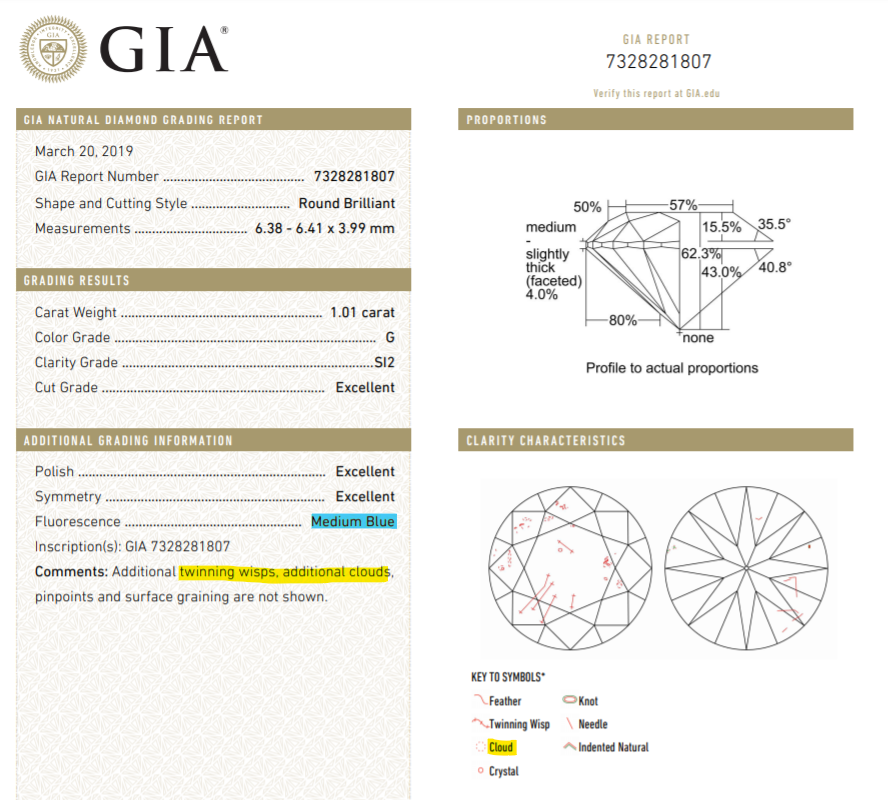
GIA diamond grading reports describe fluorescence intensity using the terms None, Faint, Medium, Strong, and Very Strong. If a diamond displays Medium, Strong, or Very Strong fluorescence, the colour of the fluorescence will also be noted on the grading report.
Diamonds can fluoresce in a variety of colours, including orangy yellow, yellow, orange, red, white, and green. These fluorescence reactions are influenced by variations within the diamond’s atomic structure, such as the presence and arrangement of trace elements like nitrogen.
Blue fluorescence, however, is by far the most common type observed in diamonds.
Source: GIA

GIA studied the effects of blue fluorescence on a diamond’s appearance under normal viewing conditions. The Institute found that average observers — representing typical jewellery buyers — could not consistently detect fluorescence-related differences in the environments where diamonds are commonly viewed and worn.
However, GIA also found that strong blue fluorescence can sometimes be beneficial. In certain diamonds, particularly those with lower colour grades, strong blue fluorescence may improve the diamond’s apparent face-up colour, making it appear whiter than its certified colour grade may otherwise suggest.
At Me Jewellery, we would generally suggest that an H–J colour diamond with strong blue fluorescence may appear brighter or whiter than its certified colour grade under some lighting conditions.
Source: GIA
Diamond fluorescence has little to no effect on a diamond’s sparkle, and research shows it does not impact beauty either.
A diamond’s sparkle (or brilliance) is determined primarily by its cut, not by whether the diamond fluoresces. The cut — including the angles and proportions of its facets, as well as its overall design and craftsmanship — determines how effectively light interacts with the diamond and how well it sparkles.
Source: GIA.
Absolutely not. The presence or absence of fluorescence should not be used as a DIY test to determine whether a diamond is real.
Not all natural diamonds fluoresce under the standard gemological UV light (see FAQ #1), and some synthetic or lab-grown diamonds do. While differences in intensity, colour, and pattern of fluorescence can occur between natural and synthetic diamonds, there is still significant overlap.
In addition, certain diamond simulants — such as cubic zirconia — may also exhibit fluorescence.
Source GIA
A diamond that fluoresces under standard UV light has the same structural integrity as one that does not. The submicroscopic features responsible for fluorescence do not inherently weaken the diamond.
Source: GIA.
Jewellery professionals tend to disagree about whether fluorescence adds to or detracts from a diamond’s value. Some trade professionals believe that very rare diamonds at the high end of the D-to-Z colour scale with extremely strong blue fluorescence are worth less than their non-fluorescent counterparts, as fluorescence can, in some cases, affect transparency and create a hazy or milky appearance. Conversely, others pay higher prices for blue-fluorescing diamonds of lower colour grades, as fluorescence may mask faint to very light yellow tones in these stones.
Source: GIA.
My comment: I’m not going to sit on the fence here. From what I’ve seen over the years, diamonds with higher colour and clarity grades are — and always will be — the most expensive, simply because they are rarer. However, if those top-graded diamonds have medium to strong fluorescence, the price will generally be lower than for comparable non-fluorescent stones.
— Mark