Facebook Pixel tracking image
Mini Cart 0

Your cart is empty.

FREE SHIPPING - 100% AUSTRALIAN DESIGNED & CRAFTED

Mini Cart 0

Your cart is empty.

Engagement Ring Guide: From Budget to Basics and Beyond

Choosing an engagement ring is one of the most exciting and meaningful purchases you’ll ever make, but it can also feel overwhelming. From setting a realistic budget to understanding diamonds and selecting the perfect design, there are many factors to consider. This guide will walk you through the key considerations involved in choosing an engagement ring, giving you the knowledge and confidence to make an informed decision.

Budget

All of the important aspects discussed above will ultimately be influenced by your budget. Establishing a clear budget from the outset will help guide your search and allow you to make informed decisions throughout the design process.

As a starting point, it is often easiest if we first estimate the cost of the ring itself. This will depend on the chosen design, metal type, finger size, and any customisation required. Once the approximate cost of the ring has been established, the remaining budget can be allocated towards the centre diamond.

From there, it’s a balancing act between diamond size and quality. If size is your priority, more of the diamond budget can be allocated towards carat weight. If quality is more important, the budget can instead be directed towards higher colour, clarity, or cut grades. Mark and Emma will guide you through these trade-offs to help you achieve the best possible result within your budget.

For example, if your total budget is $8,000 and the ring setting is estimated at $3,500, approximately $4,500 would remain for the centre diamond. This provides a clear framework for selecting a diamond that best suits your priorities.

Understanding The Basics

Before choosing an engagement ring, it’s worth familiarising yourself with a few key concepts, including centre stone selection, the 4 Cs of diamonds, diamond shapes, ring settings, and precious metal types.

Understanding these fundamentals will help you make informed decisions, as each plays an important role in the ring’s appearance, durability, and overall value.

Selecting a stone

The first decision is whether your partner would like a diamond as the centre stone, or perhaps an alternative gemstone such as a sapphire, moissanite, emerald, or opal. While this guide focuses primarily on diamond engagement rings, Emma and Mark would be happy to discuss alternative gemstone options with you.

If a diamond is the preferred choice, the next consideration is whether to choose a natural or lab-grown diamond. Budget is often a significant factor, as lab-grown diamonds are generally more affordable than their natural counterparts.

A common question is, “Are lab-grown diamonds real diamonds?” The answer is yes. Lab-grown diamonds have the same physical, chemical, and optical properties as natural diamonds; the only difference is how they are formed.

For a more detailed comparison of natural and lab-grown diamonds, visit our page Lab Grown Diamonds FAQ.

The 4 Cs

You may have heard of the 4 Cs before, but not fully understand how they influence a diamond’s appearance, quality, and value. The 4 Cs—Cut, Colour, Clarity, and Carat Weight—are the internationally recognised standards used to assess diamonds.

Understanding how these factors work together will help you determine where to prioritise your budget and which characteristics are most important to you. At Me Jewellery, Mark and Emma have extensive experience sourcing and selecting exceptional diamonds. They will guide you through the process, helping you understand the available options and ensuring you achieve the best possible outcome for your design, priorities, and budget.

For a more detailed explanation of the 4 Cs, visit our Diamond Education section.

Engagement Ring Guide: From the Basics to Budget and Beyond 2
White Diamonds

Diamond Shapes

Now it’s time to consider the shape of the diamond. A diamond’s shape has perhaps the greatest influence on a ring’s overall appearance and style. Whether you prefer a timeless Round Brilliant, an elegant Oval, or a sophisticated Emerald Cut, each shape offers its own unique character.

Ideally, you should know which shape your partner prefers before making a decision. If you’re unable to find out directly, consider asking a close friend or family member for guidance. Of all the design choices you’ll make, the diamond shape is one you definitely want to get right.

For a more detailed comparison of the various diamond shapes, visit our diamond cuts guide.

Setting

Now, let’s talk more about the ring itself. A ring’s setting secures the centre stone and contributes significantly to the ring’s overall structure and style.

Some popular engagement ring settings include:

Solitaire – A single centre stone for a timeless, minimal look.

Halo – A circle of diamonds surrounding the centre stone for added sparkle and perceived size. A popular variation of the traditional halo is the hidden halo, which sits beneath the setting.

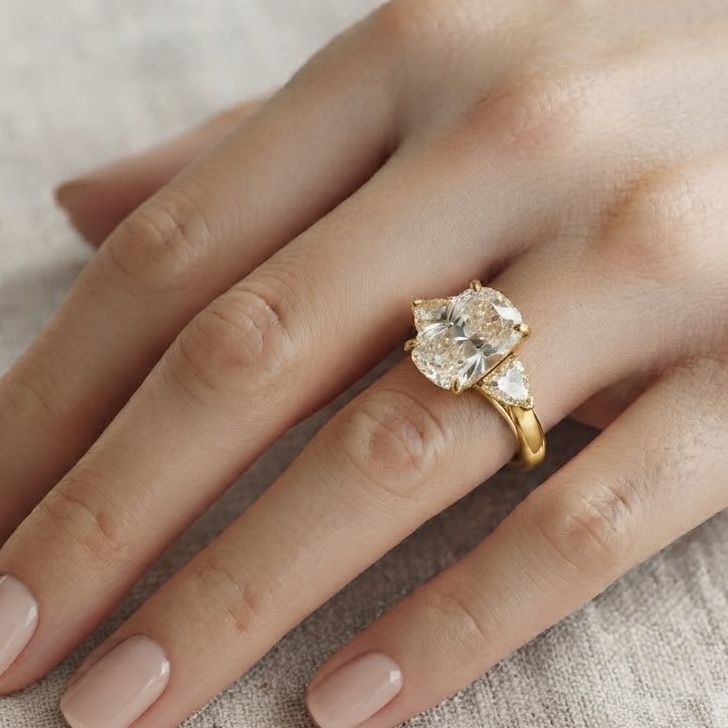
Three-Stone  – A centre diamond with two side stones for a balanced, meaningful design.

Side Stone – Larger accent diamonds along the band for added detail and structure.

Pavé – Small diamonds set closely along the band for continuous sparkle.

East-West – Elongated diamond shapes set horizontally across the finger for a modern look.

You’ll also need to consider how the diamond is secured. The most common option is a claw setting, which can be four-claw, six-claw, or occasionally double-claw. Alternatively, a bezel setting fully surrounds the diamond in metal. Both options are timeless choices, and the right option often depends on the diamond, the overall design, and also your partner’s preferences.

Finally, it is important to consider lifestyle. Some settings are more suited to active, hands-on wear, while others prioritise delicacy and more care. Remember, engagement rings are crafted from precious metal; they should be treated with care to ensure they remain in excellent condition over time.

This brings us to the next consideration: metal type.


Engagement Ring Guide: From the Basics to Budget and Beyond 6

Metal Type

The most common metals used in engagement rings are platinum, white gold, yellow gold, and rose gold. While they can sometimes appear similar, their composition, durability, and maintenance requirements differ.

Platinum – A naturally white precious metal that is typically 95% pure. It does not require plating and is renowned for its durability and longevity.

White Gold – An alloy of pure gold and naturally white metals such as palladium or silver. It is typically finished with a rhodium plating to achieve its bright white appearance.

Yellow Gold – An alloy of pure gold with other metals to improve its strength while retaining its traditional yellow colour.

Rose Gold – An alloy of gold and copper, with the copper content giving it its distinctive pink hue.

When choosing a metal, consider your partner’s personal style, lifestyle, existing jewellery, and budget. If you’re unsure, the jewellery they already wear is often the best indication of their preference.

Now that we have covered the basics, let’s discuss the importance of setting a realistic budget and timeframe, determining ring size and key future considerations.  

Timeframe and Important Considerations

It is important to consider your proposal timeline and allow sufficient time for both the design and manufacturing process. We typically require a 3–5 week period from the design approval stage to complete your ring, although this may vary depending on the complexity of your design.

Now you may be wondering, “How do I know the correct ring size?” If your partner is not involved in the design process, there are a few possible ways to work it out:

  1. Ask someone close to them – A mother, sister, or close friend may already know their ring size or be able to find out discreetly.
  2. Borrow an existing ring – If you can borrow a ring they wear on their ring finger, we can measure it for you.
  3. Have them sized in advance – If the proposal is not a complete surprise, you may wish to have your partner professionally sized before beginning the design process.

We recommend getting as close as possible to the correct ring size, as most rings can only be resized within a limited range, depending on the design.

It is also worth thinking ahead to future considerations, particularly the wedding band. Considering the type of wedding band your partner may prefer during the engagement ring design process will help ensure both pieces are compatible. Mark and Emma can guide you through this process to achieve a cohesive final result.

While trends can be appealing, they often come and go. We generally recommend choosing a design that feels classic and timeless rather than one driven by short-term trends influenced by celebrities or public figures. Finally, consider your partner’s lifestyle, occupation, and personal style to ensure the design will continue to suit them for years to come.

If you have any further questions not covered in this guide, or you’re ready to begin your design process, please visit our Contact page to get in touch! We would be delighted to help you bring your dream ring to life.